The Practical Value of Continuous Line Mountain Art for Modern Design Projects
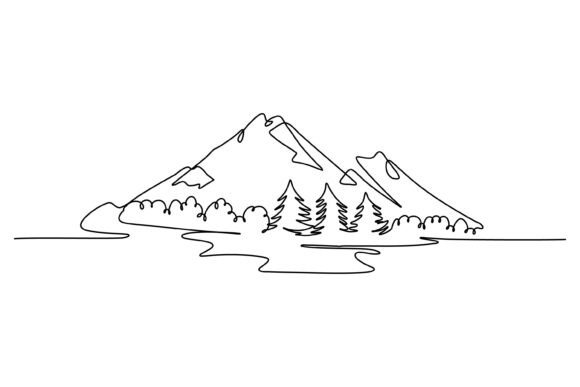
In the current landscape of digital design and branding, there is a distinct shift toward minimalism and clarity. Visual noise often distracts from the core message, leading many professionals to seek assets that communicate complexity through simplicity. One such asset gaining traction among creators and business owners is the Continuous Line Design of Mountains. This specific style of illustration, characterized by a single unbroken stroke that forms the silhouette of a mountain range, offers more than just aesthetic appeal; it provides a versatile functional tool for a wide array of projects.
When evaluating graphic resources, it is essential to look beyond the surface-level beauty and assess usability, scalability, and integration potential. A continuous line drawing of mountains covered in snow, rendered as a single decorative element on a white background, represents a high-utility asset. Whether you are a marketer building a brand identity, an educator creating course materials, or a freelancer designing a website, understanding the nuances of this design style can significantly impact the quality and efficiency of your output.
Defining the Aesthetic and Functional Core
At its heart, a Continuous Line Design of Mountains relies on the artistic principle of economy. The artist must plan the entire composition before committing to the line, ensuring that the peaks, valleys, and contours flow seamlessly without lifting the pen. This results in an image that feels organic yet structured. When these mountains are depicted with snow caps, the design often utilizes negative space or subtle variations in line weight to suggest texture and depth without cluttering the visual field.
The primary strength of this approach lies in its adaptability. Unlike detailed photographic backgrounds or complex vector illustrations with hundreds of anchor points, a single-line design is inherently clean. This cleanliness translates directly to performance in real-world applications. For web designers, this means faster load times when the image is optimized. For print professionals, it ensures crisp reproduction at any scale, from a small business card to a large-format banner.
Furthermore, the "white background" specification mentioned in many asset descriptions is not merely a default setting; it is a strategic choice for flexibility. While a transparent background is often preferred for overlay work, a high-resolution JPG or a vector file with a defined white base allows for immediate use in documents where a clean canvas is required, such as letterheads or presentation slides. However, the true power is unlocked when accessing the vector formats.
Evaluating File Formats: EPS, SVG, and JPG
When acquiring a Continuous Line Design of Mountains, the available file formats dictate how effectively you can utilize the asset. Professional workflows typically demand access to EPS, SVG, and JPG versions, each serving a distinct purpose in the production pipeline.
- SVG (Scalable Vector Graphics): This is arguably the most critical format for digital applications. SVGs are code-based, meaning they render perfectly on any screen resolution, from mobile devices to 4K monitors. For web developers and UI designers, an SVG version of a mountain line art allows for CSS styling. You can change the stroke color, adjust the line width, or animate the drawing path directly within the browser without needing external image editing software.
- EPS (Encapsulated PostScript): The industry standard for print. If you are a publisher or a packaging designer, the EPS file ensures that your continuous line design of mountains covered in snow remains sharp regardless of the printing method. It allows for full editability in professional software like Adobe Illustrator or CorelDRAW. You can isolate the line, modify the snow details, or integrate the mountain range into a larger composite illustration without losing quality.
- JPG (Joint Photographic Experts Group): While less flexible than vector formats, the JPG is indispensable for quick deployment. It is universally compatible with word processors, social media platforms, and email clients. Having a high-quality JPG version means you can drag and drop the asset into a blog post or a PowerPoint presentation immediately, bypassing the need for conversion tools.
The availability of all three formats in a single package significantly enhances the long-term value of the asset. It future-proofs your purchase, allowing you to repurpose the design across different mediums years down the line without needing to source a new file.
Strategic Applications Across Industries
The utility of a Continuous Line Design of Mountains extends far beyond simple decoration. Its abstract nature allows it to fit into various thematic contexts, making it a favorite among diverse professional groups.
Branding and Identity: For outdoor gear companies, travel agencies, or environmental nonprofits, the mountain motif is a natural fit. However, traditional logos can feel dated or overly aggressive. A single-line approach conveys modernity and elegance. It suggests movement and continuity, which are powerful metaphors for growth and resilience. Entrepreneurs looking to establish a boutique brand will find that this style differentiates them from competitors using generic stock photography.
Digital Content and Blogging: Content creators often struggle to find visuals that do not distract from the text. A subtle line drawing of mountains can serve as a section breaker or a header image that adds visual interest without competing for attention. The monochromatic nature of most single-line designs ensures they blend well with varied color schemes, maintaining the readability of the content.
Educational Materials: Educators and publishers can utilize these designs to illustrate geographical concepts or simply to add a polished look to worksheets and textbooks. The simplicity of the line art makes it easy for students to focus on the accompanying information. Additionally, because the lines are clear and distinct, they can be used as coloring activities or tracing exercises in lower-level education settings.
Quality Assessment and Usability Considerations
Not all line art is created equal. When selecting a Continuous Line Design of Mountains, several quality indicators should guide your decision. First, examine the smoothness of the curves. Poorly executed vector paths may have jagged edges or unnecessary anchor points that make editing difficult. A high-quality file will have optimized paths that are easy to manipulate.
Second, consider the balance of the composition. In a design featuring mountains covered in snow, the placement of the "snow" elements—whether indicated by breaks in the line or additional strokes—must feel natural. If the design looks too symmetrical or forced, it may lack the organic charm that makes this style effective. The best designs strike a balance between realism and abstraction.
Consistency is another factor, particularly if you plan to build a library of assets. Many designers offer series of continuous line drawings. Securing a mountain design from a cohesive set allows you to maintain a unified visual language across your website, social media, and printed collateral. This consistency reinforces brand recognition and presents a professional image to your audience.
Potential Limitations and Best Practices
While highly versatile, this design style does have limitations that users should acknowledge. Because the design relies on a single line, it may lack the depth required for projects needing high-impact drama or photorealism. It is not suitable for contexts where detailed topographical accuracy is necessary. Furthermore, if the line is too thin, it may disappear when printed on low-quality paper or viewed on low-resolution screens. Always test the asset in its intended environment before finalizing a project.
To maximize effectiveness, consider how the line interacts with other design elements. Since the background is typically white, ensure there is sufficient contrast if placing the image over colored backgrounds. Utilizing the vector capabilities to recolor the line to match your brand palette is a simple step that can elevate the integration from "stock image" to "custom design."
Final Verdict on Long-Term Value
Investing in a high-quality Continuous Line Design of Mountains is a pragmatic decision for professionals who value efficiency and aesthetic sophistication. The combination of EPS, SVG, and JPG formats ensures that the asset remains useful regardless of how technology or project requirements evolve. Its ability to convey themes of nature, stability, and ambition without visual clutter makes it a timeless choice for modern communication.
For the serious hobbyist or the seasoned agency, the difference often lies in the details. A well-crafted single-line mountain range does the heavy lifting of visual storytelling, allowing you to focus on strategy and content. By choosing assets that prioritize clean geometry and flexible formatting, you equip yourself with tools that enhance rather than hinder your creative workflow. In a market saturated with complex and noisy visuals, the quiet confidence of a continuous line design often speaks the loudest.