Elevating Visual Identity with the Disco Ball Light One Continuous Line Design
In the rapidly evolving world of graphic design and digital art, the shift toward minimalism has opened up exciting avenues for creativity. Designers and hobbyists alike are constantly searching for assets that strike a perfect balance between simplicity and visual impact. One such asset that has captured the imagination of the creative community is the Disco Ball Light One Continuous line design. This specific style of illustration does more than just depict an object; it tells a story of fluidity, connection, and modern aesthetic sensibility, all while maintaining a clean and versatile structure.
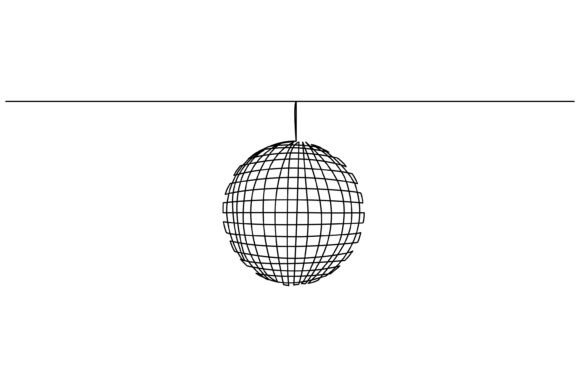
The concept behind a continuous line drawing is deceptively simple yet technically demanding. The artist creates the entire image without lifting their pen or stylus from the surface. When applied to a subject as iconic as a disco ball, the result is a mesmerizing interplay of geometry and flow. The rigid, faceted nature of a mirror ball contrasts beautifully with the organic, unbroken path of the line, creating a dynamic tension that draws the eye. For anyone looking to incorporate this into their projects, understanding the nuances of this design approach is key to leveraging its full potential.
The Art of Unbroken Flow
At the heart of the Disco ball light one continuous design is the principle of uninterrupted motion. Unlike traditional illustrations that rely on shading, multiple layers, and complex color palettes to define form, this style relies entirely on the weight and trajectory of a single stroke. This technique forces a level of abstraction that allows the viewer's brain to fill in the gaps, making the image feel interactive and engaging.
When you examine a high-quality version of this artwork, typically drawn on a pristine white background, you notice how the line weaves in and out to suggest the reflective tiles of the disco ball. It might loop around to imply the hanging mechanism or spiral downward to represent the cascading beams of light often associated with dance floors. The "light" aspect of the design is crucial here; it isn't just a static object, but a representation of energy and movement. This makes it particularly effective for brands or projects related to music, nightlife, celebration, and entertainment.
The choice of a white background is not merely an aesthetic preference but a strategic one. It ensures maximum versatility. A design isolated on white can be easily dropped into any context—whether it's a dark-mode website, a colorful social media post, or a printed flyer—without clashing with existing elements. The negative space becomes just as important as the line itself, giving the design room to breathe.
Why File Formats Matter: EPS, SVG, and JPG
When acquiring digital assets like the Disco Ball Light One Continuous design, the file formats you receive are just as critical as the artwork itself. Professional packages usually include EPS, SVG, and JPG files, and each serves a distinct purpose in your workflow.
- SVG (Scalable Vector Graphics): This is arguably the most important format for modern web and app design. Because the image is defined by mathematical paths rather than pixels, it remains crisp at any size. You can scale a tiny icon up to a billboard-sized banner without losing a shred of quality. For developers and UI designers, SVGs are lightweight and code-friendly.
- EPS (Encapsulated PostScript): This is the industry standard for print professionals. If you are designing merchandise like t-shirts, mugs, or large event posters, the EPS file allows you to open the design in software like Adobe Illustrator or CorelDRAW. Here, you have full control to edit the stroke width, change the color of the line, or even separate elements if needed for screen printing.
- JPG (Joint Photographic Experts Group): While not scalable, the JPG version provides an immediate, ready-to-use raster image. It is perfect for quick social media uploads, blog headers, or presentations where vector editing isn't required. Having a high-resolution JPG on hand saves time when you need to deploy content instantly.
Understanding these formats ensures that you aren't limited by your tools. Whether you are a seasoned graphic designer tweaking vectors or a small business owner needing a quick logo update, having access to all three formats guarantees that the Disco ball light one continuous asset fits seamlessly into your pipeline.
Practical Applications in Modern Projects
The versatility of continuous line art extends far beyond simple decoration. In today's branding landscape, companies are moving away from overly complex logos toward symbols that are memorable and adaptable. A continuous line disco ball serves as an excellent emblem for music festivals, DJ portfolios, retro-themed parties, or even tech startups that want to convey innovation and rhythm.
Consider the scenario of a wedding invitation suite with a "Saturday Night Fever" or general disco theme. Using a delicate, single-line illustration adds a touch of elegance that a photograph or a heavy, shaded cartoon simply cannot achieve. It feels sophisticated yet fun. Similarly, in the realm of interior design, this graphic can be scaled up and printed on canvas or wall decals to create a focal point in a home studio or a trendy café.
For content creators and bloggers, the clean lines of this design make it an ideal hero image. Because it is drawn on a white background, it integrates effortlessly into article layouts without requiring complex masking or background removal. The visual metaphor of "light" and "continuous motion" also works well for topics regarding productivity, flow states, or keeping the party going.
Factors to Consider Before Choosing Your Design
While the appeal of the Disco ball light one continuous style is universal, there are practical factors to weigh before integrating it into your specific project. First, consider the complexity of the line work. Some continuous line designs are incredibly intricate, with hundreds of loops and turns. While beautiful, these can become muddy when scaled down to very small sizes, such as a favicon or a mobile app icon. Look for a design that balances detail with clarity, ensuring the shape of the disco ball remains recognizable even at thumbnail dimensions.
Secondly, think about customization. One of the greatest strengths of vector formats (EPS and SVG) is the ability to modify the stroke. Do you need the line to be thicker for a bold statement, or thinner for a minimalist look? Can the color be changed to match your brand's specific hex code? A high-quality asset will allow you to make these adjustments easily without breaking the continuity of the line.
Another consideration is the surrounding context. Since the design relies on negative space, it performs best when placed against solid colors or simple textures. Placing a fine continuous line over a busy, high-contrast photograph might cause it to get lost. Always test the design against your intended background to ensure legibility.
The Enduring Appeal of Minimalism
Trends in design come and go, but the fundamental human appreciation for simplicity remains constant. The Disco Ball Light One Continuous design taps into this timeless preference. It strips away the unnecessary, leaving only the essence of the subject. In a world cluttered with information and visual noise, a clean, unbroken line offers a moment of visual calm.
Moreover, this style bridges the gap between analog and digital. It mimics the feeling of a hand-drawn sketch, bringing a human touch to digital mediums, yet it is delivered in precise, scalable digital formats. This duality makes it resonate with audiences who crave authenticity in an increasingly automated world.
Whether you are decorating a physical space, building a brand identity, or creating digital content, the utility of this design is undeniable. It offers a unique way to express energy and celebration without being loud or aggressive. The single line acts as a guide, leading the viewer's eye through the composition in a deliberate, satisfying journey.
Ultimately, adopting the Disco ball light one continuous aesthetic is about choosing clarity and style. It demonstrates an understanding of modern design principles while paying homage to a classic cultural icon. By utilizing the right file formats and understanding the strengths of continuous line art, you can elevate your projects with a graphic that is as functional as it is beautiful. The result is a visual element that doesn't just sit on the page but dances across it, capturing the spirit of the disco era through a contemporary lens.